


ANNISTON, AL — Leaders from Jacksonville State University and Gadsden State Community College presented their annual State of Higher Education report Friday, detailing substantial infrastructure investments, new academic programs, and workforce development initiatives that demonstrate significant growth across both institutions.
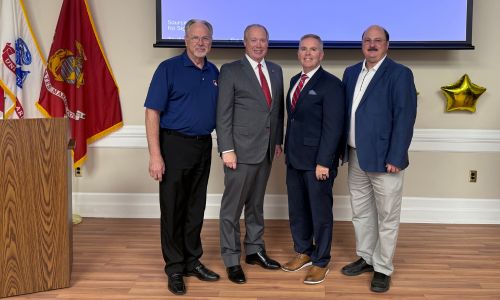
The presentation, held at the Calhoun County Chamber of Commerce boardroom, featured remarks from JSU President Don Killingsworth and Gadsden State President Alan Smith, who assumed his role ten days prior to the event. State Senator Keith Kelley and State Representative Mark Gidley attended alongside local government officials and regional business leaders.
President Alan Smith, who took the helm at Gadsden State recently, brought deep local roots and extensive experience in workforce development to his new role. Smith, whose family history includes connections to former Anniston Mayor Claude Dear and the agricultural community of Pleasant Ridge, emphasized collaboration as key to the college’s future success.
“We can’t do it alone, and I know we can do it together,” Smith told attendees. “Collaboration is key. We have about 40% of our high school graduates not wanting to enroll in a college when they graduate, and that just sets them up to be so far behind in life.”
President Smith, citing deep familial connections to Calhoun County, outlined strategic initiatives for the 100-year-old institution that serves approximately 5,000 students annually across multiple campuses.
Gadsden State’s advanced manufacturing programs, including FAME (Federation of Advanced Manufacturing Education) and COMET (Consortium of Machining Education and Training), report a 94% permanent employment rate for graduates. These programs combine classroom instruction with industry placement through partnerships with 30 regional manufacturers.
The college has launched the Impact Program in partnership with CREATE, offering dual enrollment opportunities for high school students in mechatronics, HVAC, electrical technology, industrial automation, and mechanical design technology. Students maintaining a 2.0 GPA may complete associate degree requirements by high school graduation.
Infrastructure investments at Gadsden State total approximately $50 million, including a $30 million advanced manufacturing center, new athletic facilities, and fine arts center renovations.
Jacksonville State University Announces Aviation Program Launch
President Killingsworth announced board of trustees approval for new aviation degree programs, including commercial aviation and aviation management. (More information to come)
JSU reported substantial infrastructure development totaling approximately $600 million in projects since the 2017 tornado. Current construction includes the West Village student housing complex, featuring 715 apartment-style units for upperclassmen, and the Randy Ellen Center for Performing Arts, a 1,000-seat concert hall constructed on the former First Baptist Church property.
The university’s College of Business maintains AACSB accreditation, placing it among the top 5% of business schools globally. Research initiatives include ongoing pediatric cancer studies utilizing medical cannabis oil, with faculty and students investigating enhanced chemotherapy effectiveness.
In athletics, JSU completed a successful second year in Conference USA, hosting conference championships in football and advancing to postseason competition including the Cure Bowl and NIT tournament. The university’s bowling program captured a national championship.
Regional Economic Impact Quantified
Both institutions reported substantial economic contributions to Alabama. Gadsden State documented a $270.5 billion regional economic impact, with 95% of graduates remaining in-state upon completion. Technical program graduates experience salary increases from entry-level wages of $15-18 per hour to approximately $30 per hour following program completion.
Jacksonville State, employing 1,300 individuals and enrolling 10,000 students primarily from the regional service area, contributes significantly to local economic stability. The university serves 15 counties with particular focus on Calhoun and Etowah counties.
Institutional Collaboration Emphasized
Both presidents highlighted expanding inter-institutional cooperation to create streamlined educational pathways from community college through graduate-level programs. Smith emphasized addressing the 40% of local high school graduates who do not pursue post-secondary education immediately.
“Collaboration is key,” Smith stated. “We have about 40% of our high school graduates not wanting to enroll in a college when they graduate, and that just sets them up to be so far behind in life.”
The partnership approach aims to address regional workforce requirements while providing educational opportunities designed to retain graduates within Alabama’s borders.
Legislative representatives present emphasized continued state support for workforce development initiatives, particularly the Skills for Success program funded through the Education Trust Fund. The program represents state investment in credential-based training aligned with industry demands.
